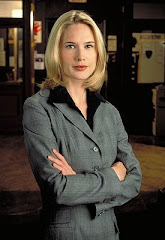
The episode we watched over the weekend really made me think about assumptions in our day-to-day lives. Although I knew that the perpetrator was dangerous, I was drawn in by the Fred Savage cute factor. How could such a kind-looking person be a rapist? This kind of thinking is biased and all the more disturbing because it is deep-seated and latent in our psyche. We would not consider this part of our assumptions regarding criminals except when confronted directly with difficuly situations like the episode, "Futility." There is no one "criminal" look, and not all criminals can be distinguished by looks. Although I wish that rapists wore convenient shirts that said "RAPIST!" so that they could be avoided, this is naive and unrealistic. Perceptions of people need to be constantly challenged so that accusations are not falsely made against anyone. No one should be persecuted for their looks, race, or any other distinguishing visual factor (or other, non-visual factors, like accent).
However, this is easily said and not so easily done. Many assumptions that are embedded deep within our minds were put there at a young age. That is why subjects like Ethnic and Women's Studies are so important; they help to identify and examine some of the stereotypes that exist in society and allow students to alter their behavior to more open and tolerant. If everyone would examine their inner assumptions and biases, then problems like racial profiling and the idea of a rapist as an dark, unknown assailant would dim. It would be easier to effectively fight crime, for the blinders of stereotypes would be removed from the process.
As the class goes on, the idea of "Whose justice?" is resonating deeply. By keeping this question at the forefronts of our minds we can more easily see the bias running rampant in America's society and justice system. So far, the barrier of class has really been underlined in the episodes we watched. As we discussed in class, the homeless man in the episode we watched in class yesterday was assumed to have done something wrong and was fair game for manipulation and bullying. However, if he had been wearing an Oxford shirt and Docker's, would the police have treated him in the same way? Also, in an episode I watched outside of class, a murderer was able to hire an entire cadre of lawyers to defend himself, whereas the poor have to depend on overstretched public defenders. Where is the equality in that sort of a system? It is something to ponder as we continue to view episodes in the future.
Tuesday, April 8, 2008

Monday, April 7, 2008
Talking Circles
Hi all! I found this website a few months ago and I have had it book marked on my computer since then. Please, if you have time, visit the site and let me know what you think! I absolutely LOVE the idea of this project. I would be very open to starting this in Corvallis or Salem (I live in Salem). But unfortunately I would not be able to dedicate the time right now. Do you think it would be hard to get response? Thanks for your thoughts...
http://www.teentalkingcircles.org/index.htm
P.S. Jean Kilbourne is the President :)
http://www.teentalkingcircles.org/index.htm
P.S. Jean Kilbourne is the President :)
Saturday, April 5, 2008
A Definite Beginning
This first episode of Law and Order established character plots, the general storyline for the plots and tied the new cast to the older one (with Abby Carmicheal making a short appearance.) Due to the premiere context of this episode, a lot of the script and actions seemed a little forced and full of inuendo. I agree with several of the other bloggers that this created some offensive moments, especially with regard to assumptions about sexual identity, victim blaming in sexual violence crimes, and the implied idea that female cops are not as mentally resilient as their male counterparts. Thankfully, most of these issues are toned down as the seasons progress, especially where Olivia is concerned. Later she takes on serial stalkers face-to-face and does not allow her personal life to interfere with any suspects, even when their crimes hit close to home.A small pet peeve that grated on me in this show were the quips from Detective Munch. I know that his character is supposed to be a little abrasive and full of dry humor, but it was a little over the top in this episode. He was honestly quite annoying! As with Olivia's character, Munch is toned down and even finds a heart later in the evolution of the show, especially with regard to the deaf doctor who he interacts with in later episodes.
I was quite struck in watching this episode with Dr. Shaw's question about who recieves justice in the Law and Order episodes. Although I don't feel that the show tries to favor the rich or any other population in its plotlines, it does strive to show the reality of the system, which is that different people recieve different levels of defense and treatment in trials. The system is very biased against the poor, in terms of bail and defense lawyers. A rich person can await trial at home while out on bail, as well as afford a cadre of the best lawyers possible. However, the poor are forced to stay in jail because they cannot afford to raise bail and are assigned public defenders who are often overworked, as many public employees are. There shouldn't be this discrepency in our justice system for the very reason that it is not justice at all. It is favoritism for the elite. Money should not act as a factor in the judicial process, which is sadly often the case often is (think of O.J. Simpson.) However, Law and Order does a good job in some epsiodes of stealing the smug smiles of the faces of those who thought they had bought there way out of a conviction when the jury returns a guilty verdict and a jail sentence is handed down. The system does work, but perhaps not as equally as we would like to think. Beyond class diferences, the judicial system also has bias as far as race, gender, and ethnicity are concerned, which is a little disquieting in a country that prides itself on equality for all. It is an ever-present demon that must be constantly faced by judicial professionals and concerned citizens.
This question of justice also spurred thought with this episode due to the idea that "we can't pick the vic," as Cragen says. The murder victim is truly a monster in his actions in the ethnic cleansing that occured in Kosovo in the nineties, yet he was also a family man who had a loving wife and child. The murderers, people we are supposed to think of as "bad," are businesswomen who endured terrible conditions and are trying to heal. Where is their justice? What is the role of international courts to bring those accused of war crimes to trial in a timely manner? Was the victim truly evil? Is anyone truly evil, or all-bad? These are rhetorical questions that lend theselves to philisophical discussions, but the role of women does appear in them. The rape victims go to jail for killing their rapists, which no one feels good about, but that is justice according to our system. Whereas I don't think that a murderer should get off free, I don't envy prosecuters the headaches they must get when grappling with these gray areas of our justice system.
I was quite struck in watching this episode with Dr. Shaw's question about who recieves justice in the Law and Order episodes. Although I don't feel that the show tries to favor the rich or any other population in its plotlines, it does strive to show the reality of the system, which is that different people recieve different levels of defense and treatment in trials. The system is very biased against the poor, in terms of bail and defense lawyers. A rich person can await trial at home while out on bail, as well as afford a cadre of the best lawyers possible. However, the poor are forced to stay in jail because they cannot afford to raise bail and are assigned public defenders who are often overworked, as many public employees are. There shouldn't be this discrepency in our justice system for the very reason that it is not justice at all. It is favoritism for the elite. Money should not act as a factor in the judicial process, which is sadly often the case often is (think of O.J. Simpson.) However, Law and Order does a good job in some epsiodes of stealing the smug smiles of the faces of those who thought they had bought there way out of a conviction when the jury returns a guilty verdict and a jail sentence is handed down. The system does work, but perhaps not as equally as we would like to think. Beyond class diferences, the judicial system also has bias as far as race, gender, and ethnicity are concerned, which is a little disquieting in a country that prides itself on equality for all. It is an ever-present demon that must be constantly faced by judicial professionals and concerned citizens.
This question of justice also spurred thought with this episode due to the idea that "we can't pick the vic," as Cragen says. The murder victim is truly a monster in his actions in the ethnic cleansing that occured in Kosovo in the nineties, yet he was also a family man who had a loving wife and child. The murderers, people we are supposed to think of as "bad," are businesswomen who endured terrible conditions and are trying to heal. Where is their justice? What is the role of international courts to bring those accused of war crimes to trial in a timely manner? Was the victim truly evil? Is anyone truly evil, or all-bad? These are rhetorical questions that lend theselves to philisophical discussions, but the role of women does appear in them. The rape victims go to jail for killing their rapists, which no one feels good about, but that is justice according to our system. Whereas I don't think that a murderer should get off free, I don't envy prosecuters the headaches they must get when grappling with these gray areas of our justice system.
First Day
Watching the first episode of SVU was definitely a different experience for me. I began watching the show well into it's first season and I agree with many of you that the shows content progressed drastically. What I appreciated the least about the first episode is how heavily it relied on the stereotypes and gender roles created and designated by society. Perhaps, the creators of the show felt this would be the quickest way to win and solidify an audience for the show. Unfortunately, U.S. society still maintains societal norms to the disadvantage of many U.S. citizens and residents.
One norm that the show definitely perpetuates is that of assumed heterosexuality and what the consequences are for those who challenge that norm. When detective Stabler, a heterosexual male, replies to the "Disco Queens" (a transgender male) sexual advances he states: "oh, I'd hurt you." The threat of violence in this instance was realistic I believe, yet unnecessary. T.V. shows have a lot of influence in our society and they should take great care to not play off of society's prejudices against those who are "different" from "everyone else." Even when playing to societal norms the show does a great disservice. Such as Olivia as the single, dedicated detective. Unlike Stabler who is both a detective and family man, Olivia has chosen her profession over motherhood thereby forfeiting, by society's standards, her ability to have a family as well.
Even with its faults I could still point out one of the shows attempt at social commentary. Like when Munch states: "What are you sheep? Will you believe anything?" Unfortunately, for the average viewer such an effort I feel would be lost amongst the gritty content and faced paced story line. Even in its first episode SVU has the makings of a sufficient vehicle for the social analysis of issues regarding sex crimes. Too bad it is television and even the best shows with the best intentions have one goal in the end, to stay on air. - Jennifer
One norm that the show definitely perpetuates is that of assumed heterosexuality and what the consequences are for those who challenge that norm. When detective Stabler, a heterosexual male, replies to the "Disco Queens" (a transgender male) sexual advances he states: "oh, I'd hurt you." The threat of violence in this instance was realistic I believe, yet unnecessary. T.V. shows have a lot of influence in our society and they should take great care to not play off of society's prejudices against those who are "different" from "everyone else." Even when playing to societal norms the show does a great disservice. Such as Olivia as the single, dedicated detective. Unlike Stabler who is both a detective and family man, Olivia has chosen her profession over motherhood thereby forfeiting, by society's standards, her ability to have a family as well.
Even with its faults I could still point out one of the shows attempt at social commentary. Like when Munch states: "What are you sheep? Will you believe anything?" Unfortunately, for the average viewer such an effort I feel would be lost amongst the gritty content and faced paced story line. Even in its first episode SVU has the makings of a sufficient vehicle for the social analysis of issues regarding sex crimes. Too bad it is television and even the best shows with the best intentions have one goal in the end, to stay on air. - Jennifer
Wednesday, April 2, 2008
Emotional Olivia
I like that both of the other posts talked about how Olivia was portrayed as emotional in this first episode. We all agree that this is not so much the case with current episodes. I wanted to reflect a little more about this concept.
What bothered me about Olivia's character being more emotional than the other characters was the implication that since she was emotional, she would not be allowed to perform her job. I understand that as a police detective, one must adhere to policies and procedures as well as keep a strict presence of professionalism, but why is it that they cannot express their emotions? It seemed to me that this was another play into the stereotypes of women and how the way women "normally" act is not valued, especially in this noticeably male dominant unit. Is being emotional equal to being feminine? Can only men be successful on the SVU team because they do not cry or expose a personal feelings towards a case? "No crying in baseball..." (or on this team in the NYPD). These are the impications of the characters' dialog and actions on this initial episode.
Also, it is odd to me that with sex crimes committed primarily against women, the show presumed that only men could "handle" this work. Really? Shouldn't we have more women involved because the crimes pertain to women? Or maybe this was a way for the writers to expose issues of violence against women by making Olivia overcome with emotion on the first episode. I could go both ways. But if the intention was to bring light to the fact that sex crimes are predominantly committed towards women, it is interesting that the writers had to create buy in from viewers about the oppressing stereotypes of women. It just made me mad to see how much masculinity was valued in this context as it is in so many others ways in our society. I am glad that we know further down the road how awesome Olivia's character becomes and how much respect she gains and demands from her coworkers and superiors in future episodes.
What bothered me about Olivia's character being more emotional than the other characters was the implication that since she was emotional, she would not be allowed to perform her job. I understand that as a police detective, one must adhere to policies and procedures as well as keep a strict presence of professionalism, but why is it that they cannot express their emotions? It seemed to me that this was another play into the stereotypes of women and how the way women "normally" act is not valued, especially in this noticeably male dominant unit. Is being emotional equal to being feminine? Can only men be successful on the SVU team because they do not cry or expose a personal feelings towards a case? "No crying in baseball..." (or on this team in the NYPD). These are the impications of the characters' dialog and actions on this initial episode.
Also, it is odd to me that with sex crimes committed primarily against women, the show presumed that only men could "handle" this work. Really? Shouldn't we have more women involved because the crimes pertain to women? Or maybe this was a way for the writers to expose issues of violence against women by making Olivia overcome with emotion on the first episode. I could go both ways. But if the intention was to bring light to the fact that sex crimes are predominantly committed towards women, it is interesting that the writers had to create buy in from viewers about the oppressing stereotypes of women. It just made me mad to see how much masculinity was valued in this context as it is in so many others ways in our society. I am glad that we know further down the road how awesome Olivia's character becomes and how much respect she gains and demands from her coworkers and superiors in future episodes.
Tuesday, April 1, 2008
First Day of Class
The first episode was definitely a "first" episode. They tried a lot of different things to draw in the audience, the innuendos most notably-perhaps to garner a laugh in spite of the serious subject manner- but also the importance of family for Stabler, the emotional side through Olivia and so on. This episode was definitely not as violent as some of the newer ones, although this had plenty of violence. Often I can not watch this show because it gets to be too gruesome. However, it still has plenty of drama and intrigue and I find myself sitting down to watch it whenever I get the chance! I had never seen this episode so it was really interesting to find out the back-stories of some of the characters. This was something I had missed out on by not closely following the show.
I was a little peeved that they made a lot of suggestions about gays and transgendered people in a comical way. I was surprised they did this because I cannot remember ever really hearing or noticing those comments in recent episodes. I also noticed that they really had stereotyped the characters. This was probably done to give a broad overview of each individual and it seemed like each one was very concentrated. Olivia is emotional and empathetic, Stabler is the all around macho family man, etc. I'm glad they have added some more depth to these characters through the seasons!
I was a little peeved that they made a lot of suggestions about gays and transgendered people in a comical way. I was surprised they did this because I cannot remember ever really hearing or noticing those comments in recent episodes. I also noticed that they really had stereotyped the characters. This was probably done to give a broad overview of each individual and it seemed like each one was very concentrated. Olivia is emotional and empathetic, Stabler is the all around macho family man, etc. I'm glad they have added some more depth to these characters through the seasons!
First Episode "Payback"
I think that this first episode was meant to set the tone for the show and it did that well enough I think. It is very different than how the show is now, several seasons later, as I think the some of the characters have been changed/modified. Olivia in the first episode was more typecast as the "emotional woman" who thinks more with her heart (as exhibited by when Cragen told Stabler to make sure his partner (Olivia) knew that they don't get to pick the victim). The male characters were also stereotyped into the very "macho" tough-talking kind of roles. That has changed over time in the show, but I think that for this episode to set the tone for the show and hook viewers in, it did need to be not as "deep" and more stereotypical to get viewers to relate.
This episode, and bearing in mind that it is a television show, was meant to draw viewers in and give them something they could recognize (emotional woman, strong men, effeminate gay man) though these are all major stereotypes. However, I do believe that perhaps that was necessary for them to do in order to introduce viewers to the show.
This episode, and bearing in mind that it is a television show, was meant to draw viewers in and give them something they could recognize (emotional woman, strong men, effeminate gay man) though these are all major stereotypes. However, I do believe that perhaps that was necessary for them to do in order to introduce viewers to the show.
Subscribe to:
Posts (Atom)